How to handle research fatigue in a qualitative project
These are our top tips for designing qualitative studies to manage research fatigue.

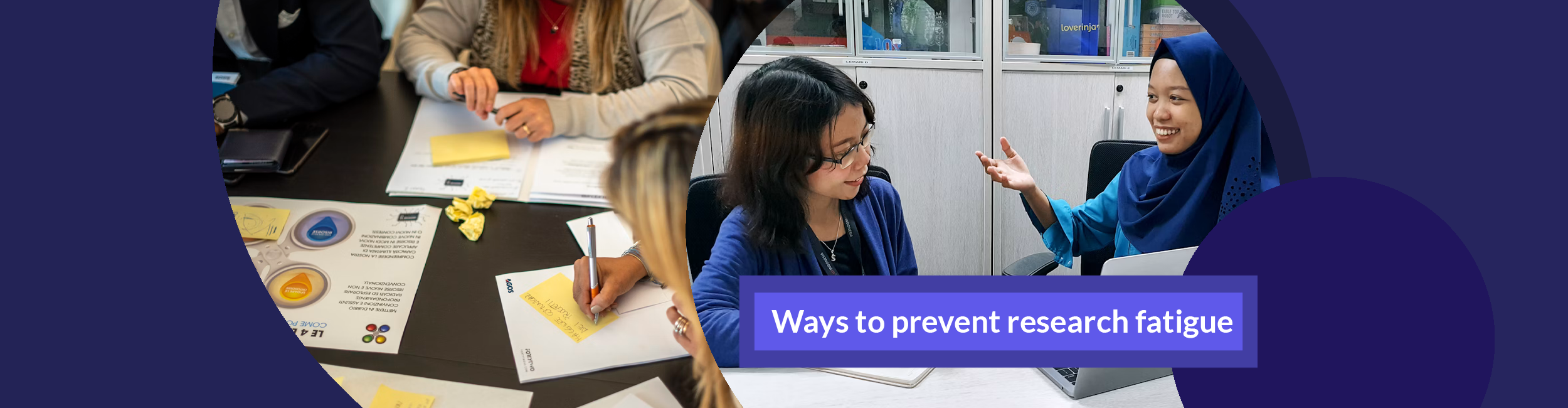
In our previous post, we talked about research fatigue, when participants become tired and reluctant to participate in further research projects. In this post, we'll go into what you can do about it, with tips to prevent or mitigate research fatigue.
Consider why people actually take part in research.
When thinking about research fatigue, it can be helpful to consider common motivations for taking part in research, and how these can be promoted in your research design and aims. As well as more direct forms of compensation for participation, Clark (2008) notes the following reasons:
- People like to feel like they can make a positive contribution and help others, including the researcher and those outside their immediate community
- "Curiosity" about the research process
- "Subjective interest" in the research topic
- Qualitative research methods can be emotionally cathartic or 'therapeutic' to engage with, and provide opportunity for 'introspection'
- "Favourable recommendations from trusted professionals" about the research or researcher
- And having 'nothing to lose' from participating!
Preliminary fieldwork: understanding the research that has come before
Kelly (2021) suggests spending time "gaining context-specific knowledge [...] in advance of the data gathering period", although also notes that "budgetary and time constraints" can make it difficult to give this step the measured approach it deserves. Preliminary fieldwork can help you start to build reciprocal and mutually trusting relationships with potential participants (Maar et al. 2011), identify the existence of or risk of research fatigue, and get a sense of people's previous experiences with research.
Of course, it's also important to identify the existing literature in the area, and how frequently your target sample may have taken part in similar studies, particularly paying attention to the design and methods they used (Ashley 2021; Button and Aiken 2022). If there isn't much literature to draw from, that's where preliminary fieldwork would be especially helpful.
It can help if you can directly ask people about the prior research done in their community. This "avoid[s] repetition, facilitate[s] awareness of the extent of requests, and provide[s] greater opportunities for meaningful partnerships and collaborations" (Cleary et al. 2016), and also makes sure the research is impactful by covering gaps or unexplored issues. If people are sick of particular methods they may be interested in a new approach (Ashley 2021; Banki and Phillips 2022), or may prefer a method that they've come to expect (Button 2022). If they had a negative experience with a previous research project, show them how you and your study will do things differently (Clark 2008) and deliver on it.
Effective communication with participants
Be upfront and honest about the intents and potential positive impacts of your study, as well as potential risks and costs. It could even be helpful to include the risk of research fatigue in your consent forms, so participants are aware this is a possibility (Ashley 2021).
Clark (2008) notes "using change as a mechanism to support engagement is something of a double-edged sword": it's a great way for people to feel positive about contributing to research, but disappointing if the change does not then materialise. Be honest that singular research projects often don't make huge changes by themselves, and give a realistic timeline of when they might expect some change to happen. For research-fatigued populations, vague promises about positive impact can be a reason not to participate (Sukarieh and Tannock 2013). If participants don't agree that you've given them a good reason to participate, reconsider your study's focus and whether it aligns with the priorities of the community (Maar et al. 2011).
Be respectful of people's time and attention when you're inviting them to take part. Don't push hard past an initial 'no', or send follow-up communications too frequently if you didn't get a response (Kelly 2021).
 Daniel Turner
Also consider different cultural approaches to consent when considering your study design and communications – Rolin (2025) and Maar et al. (2011) note that some Indigenous communities take a more communal and collective approach in approving research, to ensure that projects will benefit the whole community.
As well as ensuring people understand the purpose of the study, make clear what is required for participation, so people are not taken aback by unexpected time commitments. Make sure people know if they are going to an interview, focus group or workshop, or if you just want to have an informal chat with them (Kelly 2021).
Also, clarify your own commitments and boundaries to participants. If you promise to keep in touch with people after the project has ended or give them a chance to edit their transcripts, make sure you keep that promise (Sukarieh and Tannock 2013; Kelly 2021). People may feel exploited if they feel you have only built rapport and befriended them so they can give you the data that you need (Sukarieh and Tannock 2013, Zill 2022). This is itself probably worth a blog post itself, but for now let's just say it's important to be upfront about your professional boundaries!
Finally, think about how you are going to disseminate results to participants, (which you generally should do) as people will generally want to know what they have contributed to! It can be worth planning a reasonable number of sessions to give progress updates over time during the project, as well as sharing your results once the project is complete (Haggerty et al. 2020). Of course, make sure that you share with participants if the study has successfully made a positive change!
Flexible, participant-focused research design
When you know the research that has come before you and the impact it had on participants, this gives you an opportunity to design your project differently. You might just need to make small adjustments, like not asking questions that you know other research studies have already asked (Clark 2008; Kelly 2021).
But if working with a research-fatigued group, consider switching to a methodology that is novel to participants. Creative and interactive methodologies are commonly suggested (Banki and Phillips 2022; Cleary et al. 2016), but note they can still require a lot of energy, even if they may be more enjoyable to many participants (Ashley 2021; Kelly 2021). Participant observation is also sometimes suggested as it can be a bit more hands-off, versus holding intense one-to-one interviews, but these types of projects are commonly extractive and more fatiguing if participants have been part of observation-based studies in the past (Broskevičová et al. 2024; Kelly 2021). The difficulty is that once a methodology becomes familiar, it becomes less of a draw to take part by itself. Novelty by itself is not always enough to curb research fatigue.
It's also worth considering ways to design your research in a way that prioritises enjoyment and pleasure in the process, which may help people retain interest in the study and make the process less exhausting (Ashley 2021; Banki and Phillips 2022).
Participatory, collaborative and community-based research design
People may feel more respected and listened to in the research process if they can play a greater role in designing and co-producing the research. Consider including co-researchers who belong to the group you are researching (Ashley 2021), and participatory methodologies where participants can have greater agency and control over each stage of the project. This can sometimes help make projects more reciprocal and tailored to community needs (Rolin 2025).
Daniel Turner
However, these methods tend to require greater commitment and energy from participants. Methodologies like participatory action research aim to produce change more substantially and immediately, but don't necessarily guarantee this and may still remain extractive and exploitative of participants, particularly if used only to 'get around' research fatigue (Broskevičová et al. 2024; Kelly 2021; Sukarieh and Tannock 2013). When handled poorly it may feel like the researcher, who is typically being paid from a research/funding grant, is 'outsourcing' their decisions and research to unpaid participants. Note as well that collaborative, participatory methods can be impacted by existing power dynamics in the community which then resurface in the collaboration (Broskevičová et al. 2024).
Research that involves participants less
If a community feels very over-researched, it might be worth considering other avenues of research that are less intrusive and don't contribute to research fatigue. Document, cultural and archival research can all function as ways to study a community without exhausting or harming them, particularly if collecting data from them directly might involve repetitively giving traumatic testimony (Kelly 2021). With growing open data archives, this type of research is becoming more accessible and may function as one way to continue hearing from people who feel extremely fatigued by direct engagements with researchers (Kelly 2021; Okune 2020). And there is always secondary research from existing data!
Order a physical or digital copy today!
Changing research topic or focus
Arguably, this should be the last solution you consider. Changing the community you research solely due to being 'over-researched', without rethinking your approach to be less extractive, might just give a new group of people research fatigue (Aiken 2022; Sukarieh and Tannock 2013). It also takes an opportunity for change out of the hands of the people you had initially intended to research (Koen et al. 2017).
If you are wondering about changing the topic of your research and the people you want to work with, it is worth reflecting on the following two questions:
- Have you have chosen the community you wish to study based only on convenience, trends or available funding opportunities?
- Are they genuinely the best and only people who can answer the questions you have?
Institutional changes to research and education
Some problems with research fatigue must be solved institutionally, rather than individually. It will take a long time for institutions to rethink the foundations of academic knowledge and its reliance on extractive methods, and legitimise new ways of knowing, but we should still strive towards it (Aiken 2022).
Suggested institutional changes by Rolin (2025), Maar et al. (2011) and Sukarieh and Tannock (2013) include:
- Including education about academic extractivism and the historical exploitation of marginalised groups by researchers in research methods training
- Reforms to ethical review which take research fatigue into account
- Rewarding work that gives participants a more active and empowered role in research
However, genuine institutional change must be distinguished from performative changes which remain exploitative of marginalised groups, both within and outside academia. This can sometimes manifest as a focus on "raising awareness" of a problem without actually making any efforts to solve it, as well as the expectation that academics from marginalised groups should volunteer their time towards liberation groups and educating their colleagues and students about oppression (Rolin 2025).
Researcher reflexivity
As well as thinking about how you can go about your research more flexibly to meet the needs of the people you're researching, research fatigue is a sign to more deeply consider your role and position of power as a researcher, and ultimately question whether your aims are aligned with those of the people whose lives you are researching (Button 2022).
Research fatigue shouldn't just be viewed as a barrier for researchers to 'get around'. This can ultimately result in people continuing to feel exploited and fatigued around their participation in research (Button 2022; Aiken 2022). But it functions as a warning about the kinds of research that your participants are familiar with – often extractive and non-reciprocal in nature (Sukarieh and Tannock 2013). It can function as an invitation to you to consider how to design your research to be more responsive to people's needs, respectful of their time and energy, and less likely to fatigue them in the future.
But considering research fatigue in the planning stages, and being conscious of it during the research project, will improve the quality and experience for both the researcher and participants, as well as lay a positive groundwork for future projects.

Bibliography and further reading
Aiken, G. T. (2022). Towards a theory of over-researched places. In C. Button & G. T. Aiken (Eds), Over researched places: Towards a critical and reflexive approach (pp. 6–23). Routledge.Ashley, F. (2021). Accounting for research fatigue in research ethics. Bioethics, 35(3), 270–276.
Banki, S., & Phillips, N. (2022). Overcoming Over-Research: The MMP Approach. In K. Grabska & C. R. Clark-Kazak (Eds), Documenting displacement: Questioning methodological boundaries in forced migration research (pp. 309–337). McGill-Queen’s University Press.
Broskevičová, Z., Gřundělová, B., & Kowolová, I. (2024). “It Puts Them in the Role of Zoo Animals”: Gatekeeping, Research Fatigue and Over-Researched Populations in Czech Social Work Research. Journal of Social Service Research, 50(4), 548–561.
Button, C. (2022). Ghosts of researchers past, present and future in Mumbai. In C. Button & G. Taylor Aiken (Eds), Over researched places: Towards a critical and reflexive approach (pp. 57–69). Routledge.
Button, C., & Aiken, G. T. (2022). Over-research: What, why, when, where, how? In C. Button & G. T. Aiken (Eds), Over researched places: Towards a critical and reflexive approach (pp. 1–5). Routledge.
Clark, T. (2008). 'We’re Over-Researched Here!': Exploring Accounts of Research Fatigue within Qualitative Research Engagements. Sociology, 42(5), 953–970.
Cleary, M., Siegfried, N., Escott, P., & Walter, G. (2016). Super Research or Super-Researched?: When Enough is Enough… Issues in Mental Health Nursing, 37(5), 380–382.
Goodman, A., Morgan, R., Kuehlke, R., Kastor, S., Fleming, K., Boyd, J., & Aboriginal Harm Reduction Society, W. (2018). “We’ve Been Researched to Death”: Exploring the Research Experiences of Urban Indigenous Peoples in Vancouver, Canada. International Indigenous Policy Journal, 9(2).
Haggerty, J., Jacquet, J., Taylor, S., Theodori, G., & Walsh, K. B. (2020). Engaging in Energy Communities: The role of the researcher. A workbook and planning guide. Montana State University.
Kelly, G. (2021). Researching Over-Researched Societies. In R. Mac Ginty, R. Brett, & B. Vogel (Eds), The Companion to Peace and Conflict Fieldwork (pp. 47–63). Springer International Publishing.
Koen, J., Wassenaar, D., & Mamotte, N. (2017). The ‘over-researched community’: An ethics analysis of stakeholder views at two South African HIV prevention research sites. Social Science & Medicine, 194, 1–9.
Maar, M. A., Lightfoot, N. E., Sutherland, M. E., Strasser, R. P., Wilson, K. J., Lidstone-Jones, C. M., Graham, D. G., Beaudin, R., Daybutch, G. A., Dokis, B. R., Lesage, M. T., Raymond, M., & Williamson, P. (2011). Thinking outside the box: Aboriginal people’s suggestions for conducting health studies with Aboriginal communities. Public Health, 125(11), 747–753.
Myrsep, A. de B. (2022). ‘Research has killed the Israeli-Palestinian conflict’: Navigating the over-researched field of the West Bank. In C. Button & G. Taylor Aiken (Eds), Over researched places: Towards a critical and reflexive approach (pp. 81–99). Routledge.
Neal, S., Mohan, G., Cochrane, A., & Bennett, K. (2016). ‘You can’t move in Hackney without bumping into an anthropologist’: Why certain places attract research attention. Qualitative Research, 16(5), 491–507.
Okune, A. (2020). Open Ethnographic Archiving as Feminist, Decolonizing Practice. Catalyst: Feminism, Theory, Technoscience, 6(2).
Rolin, K. H. (2025). Resisting epistemic exploitation: From institutional remedies to community-based research. Studies in History and Philosophy of Science, 111, 63–71.
Sukarieh, M., & Tannock, S. (2013). On the Problem of Over-researched Communities: The Case of the Shatila Palestinian Refugee Camp in Lebanon. Sociology, 47(3), 494–508.
Zill, M. (2022). Confessions of an ‘academic tourist’: Reflections on accessibility, trust, and research ethics in the ‘Grandhotel Cosmopolis’. In C. Button & G. Taylor Aiken (Eds), Over researched places: Towards a critical and reflexive approach (pp. 133–148). Routledge.